Create a cooling backup before a hot day disrupts the household
Heat planning works best before a room becomes uncomfortable or transport becomes difficult. Older adults may be more vulnerable because of health conditions, medicines and changes in temperature regulation. A useful plan connects a cool place, a way to reach it and a person who knows when to check in.
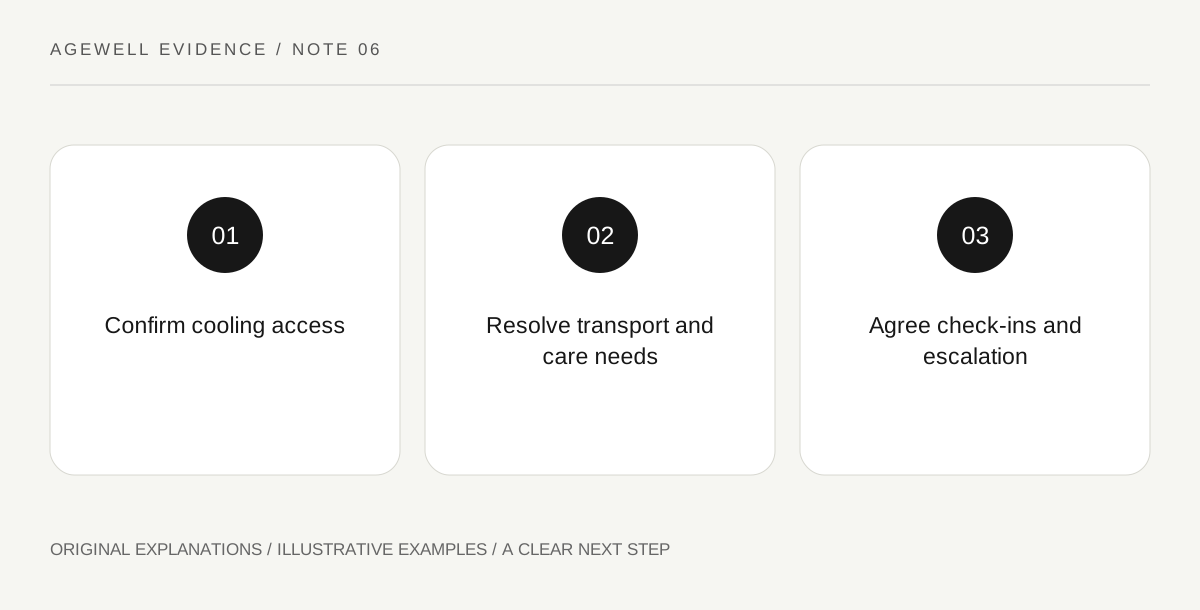
Original explanatory diagram. Read the full method and limitations below.
Identify a genuinely usable cool place
Look beyond whether a building has air conditioning. Can you reach it, enter it and stay there during the hours you need? Check transport, seating, toilets and opening information directly. A library listed on an old notice may not be open on a holiday, and a distant relative's cool house is not a backup if nobody can provide transport.
At home, identify the coolest usable room and whether equipment is functioning. Ask for help with maintenance that you cannot do safely. Keep essential contacts and a charged phone accessible. The plan should account for pets, mobility equipment and care needs that might otherwise make leaving home impractical. Avoid making a promise to relocate without solving those details.
Discuss fluid and medicine questions personally
General advice to drink fluids does not settle an individual's needs when a clinician has prescribed a fluid restriction or a condition affects intake. Ask your care team what to do during heat. Do not impose a fixed amount on everyone in the household or change a restriction because an online article uses a universal number.
Medicines can also affect heat responses. Bring questions to a clinician or pharmacist and keep the existing plan until advised otherwise. Ask how heat-sensitive products should be stored and what to do if cooling fails. Do not leave medicines in a hot vehicle as part of a relocation plan. Product-specific storage directions remain important during an unusually hot week.
Make check-ins specific
Agree who checks on whom, through which channel and what happens if there is no answer. A message that merely says 'stay cool' does not establish whether the person has cooling or needs help. Ask practical questions about the room, transport and ability to get needed supplies. Respect the person's preferences while making assistance easy to request.
Choose a backup contact who knows the plan. Keep addresses and entry arrangements available to the people authorized to help. Avoid relying on a single phone notification that could be missed. The frequency and type of check-in should fit the person's circumstances, local guidance and care needs, rather than becoming a generic schedule imposed on every older adult.
Know when the plan becomes urgent
NIA identifies heat illness as a serious risk. Learn current local advice about warning signs and emergency response before the weather worsens. Confusion, collapse or suspected heat stroke requires emergency help, not a wait-and-see household survey. A written plan should make it easy for a helper to recognize when ordinary check-ins are insufficient.
After a hot day, review the weak link. Did the transport option fail? Was the cool building closed? Was a phone number wrong? Fix that point while the details are clear. A cooling plan reduces avoidable barriers but cannot guarantee safety in every heat event, so remain responsive to official warnings and individual health advice.
An illustrative cooling plan
Nora's apartment has unreliable cooling. Before a forecast hot period, she confirms a nearby community building's opening hours and arranges transport with her daughter. They agree on a backup contact and ask her clinician about an existing fluid restriction. When the building closes early, the second location is already identified.
Practical checks
Optional checkboxes save only in this browser.
Questions that come up
Is a fan always an adequate backup?
Do not assume it is enough in dangerous heat. Follow current official heat guidance and arrange access to an appropriately cool place when needed.
Should I stop a medicine that affects heat tolerance?
Do not change medicines on your own. Ask a clinician or pharmacist how your products and health conditions affect the heat plan.
References and scope
These sources support the factual background. Examples and exercises are original illustrative teaching material. References do not imply endorsement.
- NIA: Hot Weather Safety for Older Adults — Older adults' heat vulnerability, cooling arrangements and heat illness.