Read a healthy-aging study by naming its outcome before its headline
A study can measure a blood marker, a test score, daily function or years of follow-up. Those outcomes answer different questions. Reading the outcome first helps you understand what a healthy-aging finding actually adds, without either dismissing research or expanding a preliminary result into a promise of longer life.
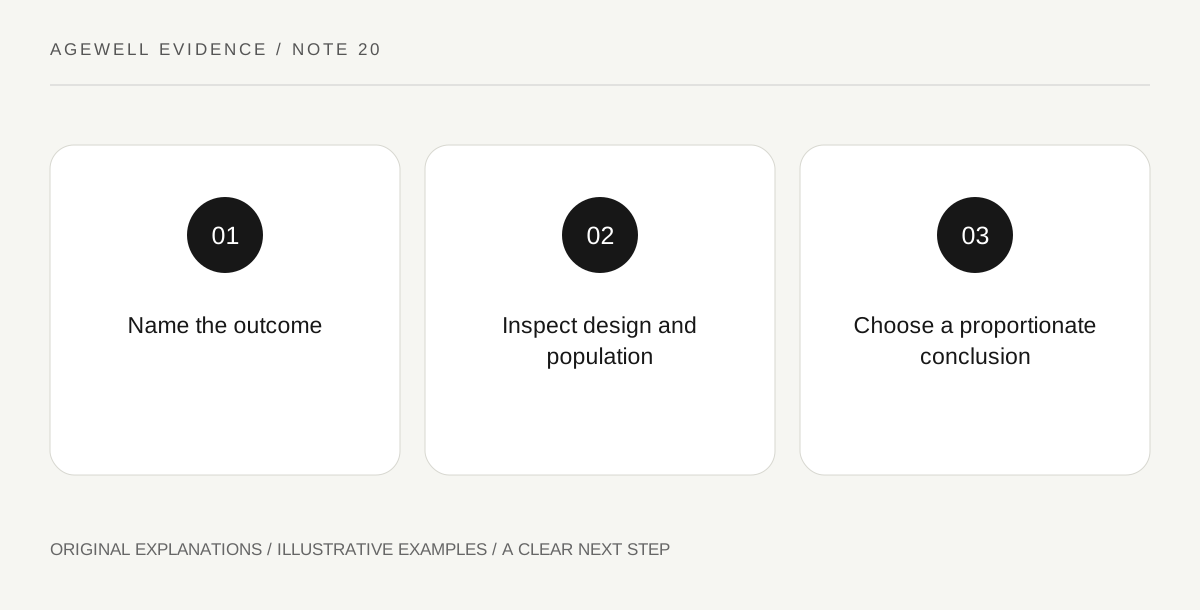
Original explanatory diagram. Read the full method and limitations below.
Write the measured outcome in one sentence
Find what researchers measured and when. Was it a laboratory value after several weeks, a walking task at a follow-up visit or the number of clinical events over years? Preserve that description before reading a promotional interpretation. A change in one measurement should remain a change in that measurement unless further evidence supports a broader conclusion.
An illustrative sentence might be 'The study compared performance on a specified task after the intervention.' That is less exciting than 'aging reversed,' but it is more informative. If the public summary never names the outcome clearly, keep the question open. Do not fill the gap with the most ambitious interpretation suggested by the title.
Identify the comparison and study design
NIA explains that observational studies follow patterns while clinical trials test interventions. Ask what the comparison actually was: usual activity, another intervention, placebo or a different group observed over time. A before-and-after change in one group may have explanations beyond the intervention. Design affects what conclusions can reasonably be drawn.
For a trial, look for how participants were assigned and whether the study was intended to establish safety, explore an early signal or test a clinical benefit. For observational work, ask what other differences between groups may matter. You do not need to calculate statistics yourself to notice that two designs answer different kinds of questions.
Check whose experience the result describes
Record the participants' relevant characteristics and how many completed the study. Age range alone does not establish that the findings apply to everyone in that range. Health status, location, eligibility criteria and support during the study can affect relevance. A closely monitored research setting may differ from a product used without supervision.
Keep the duration visible too. A short study may provide useful early information without answering questions about long-term benefit or harm. If the outcome was measured only among completers, ask how missing information was handled. These are questions for interpretation, not reasons to declare every imperfect study worthless or to assume that a larger number automatically settles the issue.
Translate the result into a proportionate action
A reasonable action may be learning more, discussing a concern with a clinician or waiting for further research. A publication does not require you to buy a test or alter treatment. Ask what would change in your care and whether established guidance already addresses the practical goal you have.
Keep research curiosity separate from personal experimentation with medicines or unverified interventions. If you want to participate in research, ask about a legitimate study and its consent process. The useful endpoint of reading is an accurate statement of what is known, what remains uncertain and whether any personal decision actually follows from that evidence.
An illustrative headline translation
A fictional article says a program made participants younger. The reader finds that the study measured a specific laboratory marker after a short period. They rewrite their note to name that marker and duration, then ask whether daily function or clinical outcomes were measured. They do not convert the finding into a treatment instruction.
Practical checks
Optional checkboxes save only in this browser.
Questions that come up
Are biomarker studies unimportant?
No. They can contribute useful scientific information. The limitation is treating a marker change as proof of a broader outcome that the study did not measure.
Does publication mean I should change my routine?
Not automatically. Ask whether the evidence supports a personal action and discuss medically significant changes with an appropriate professional.
References and scope
These sources support the factual background. Examples and exercises are original illustrative teaching material. References do not imply endorsement.
- NIA: What Are Clinical Trials and Studies? — Observational research, trials, participation questions and uncertainty.
- NIA: Cognitive Health and Older Adults — Cognitive health, research limitations and mentally engaging activities.