Before joining a study, map the visits as carefully as the hoped-for benefit
A clinical study can contribute to knowledge while requiring travel, tests, time and uncertainty. Understanding that practical burden is part of informed participation. A study invitation is not a promise of better care or a successful treatment, and ordinary healthcare continues to matter while research is underway.
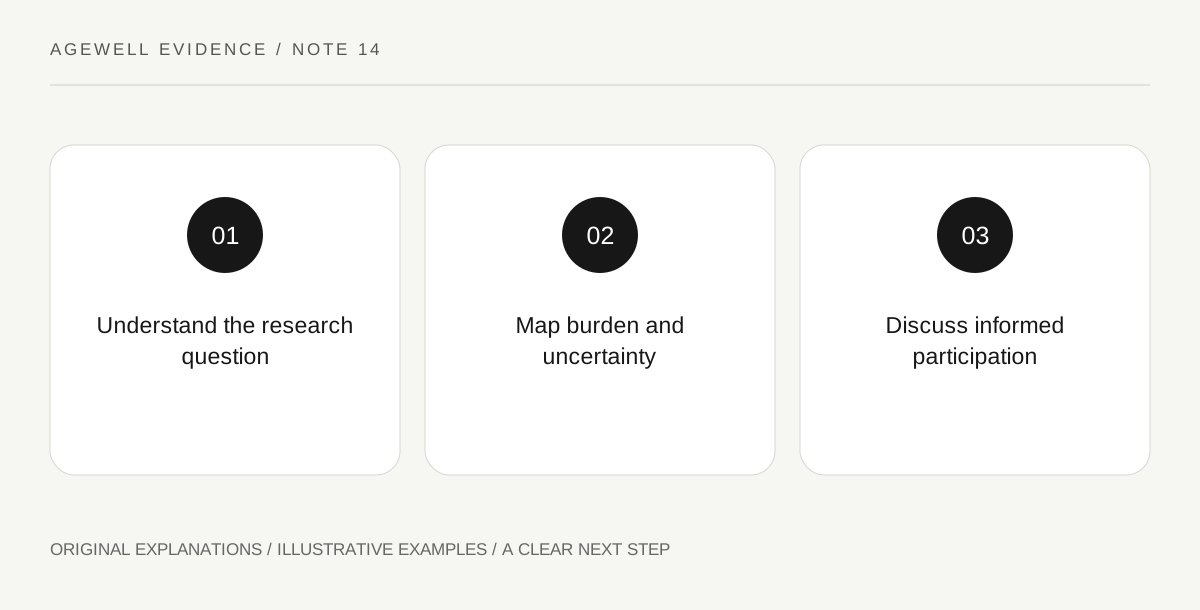
Original explanatory diagram. Read the full method and limitations below.
Identify what kind of research is proposed
NIA distinguishes observational studies from clinical trials that test an intervention. Ask what participants actually do and what question the study aims to answer. Providing questionnaires, undergoing imaging and taking an experimental product are different commitments. The word research alone does not describe the experience or the likely personal benefit.
Ask whether assignment is randomized, whether a comparison or placebo group is used and what information you may not know during the study. Have the team explain unfamiliar terms in plain language. Do not assume that a registered study has already demonstrated its intervention works. Research exists partly because important answers remain uncertain.
Map a realistic participation week
Request the schedule of visits, expected duration, remote tasks and any fasting or preparation instructions. Put travel, waiting and recovery time into the calendar as well as the appointment itself. Ask whether a supporter needs to attend and whether the site can accommodate mobility, hearing, language or other access needs.
Discuss reimbursement, parking, transport and what costs remain yours. An apparently short visit can become a long day if buses are infrequent. Ask what happens when you are ill, miss a visit or need to change a date. A practical mismatch is a legitimate consideration, not evidence that you lack commitment to science.
Understand the care and safety arrangements
Ask who monitors problems, whom to contact outside ordinary hours and how the research team coordinates with your usual clinicians. Discuss whether existing medicines or care could be affected. Never change treatment simply to appear eligible. The study team needs accurate information to assess whether participation is appropriate.
Read the consent material at a pace that allows questions. Ask about foreseeable risks, uncertainty, privacy, access to results and what happens if you withdraw. Consent is a continuing understanding, not merely a signed page. Bring a trusted person if you want help thinking through the explanation, while preserving your own preferences and decision-making role.
Ask how participation ends
Clarify the study's duration and whether an intervention continues afterward. Ask how results will be communicated and whether individual findings will be returned. Some research measurements may not be designed to guide personal clinical care. Avoid assuming every test performed will produce a health report you can act on.
Keep the study contact, consent copy and schedule accessible if you participate. Tell the team about relevant changes and continue ordinary care as advised. Choosing not to join, or deciding to withdraw through the appropriate process, does not make you an unhelpful patient. A sound decision weighs contribution, personal circumstances and uncertainty rather than only the most hopeful sentence in recruitment material.
An illustrative visit map
A study invitation mentions three clinic visits. Leila asks about travel, scans and remote questionnaires, then finds that each visit requires half a day away from caregiving. She asks about available support and discusses the study with her usual clinician. The final decision considers both research purpose and the actual household commitment.
Practical checks
Optional checkboxes save only in this browser.
Questions that come up
Does a study listing mean the treatment is proven?
No. A listing describes research; it does not establish that an experimental intervention is effective or appropriate for you.
Can I ask for more time before consenting?
Ask the team for the time and explanations you need. A meaningful consent process should allow questions about the specific study and your participation.
References and scope
These sources support the factual background. Examples and exercises are original illustrative teaching material. References do not imply endorsement.
- NIA: What Are Clinical Trials and Studies? — Observational research, trials, participation questions and uncertainty.