What a better brain-game score does and does not tell you
Improving at a game can be satisfying without proving that everyday memory has improved or that dementia has been prevented. The useful question is what the activity trains and where any benefit was measured. Keeping enjoyment separate from a medical promise helps you choose learning activities with realistic expectations.
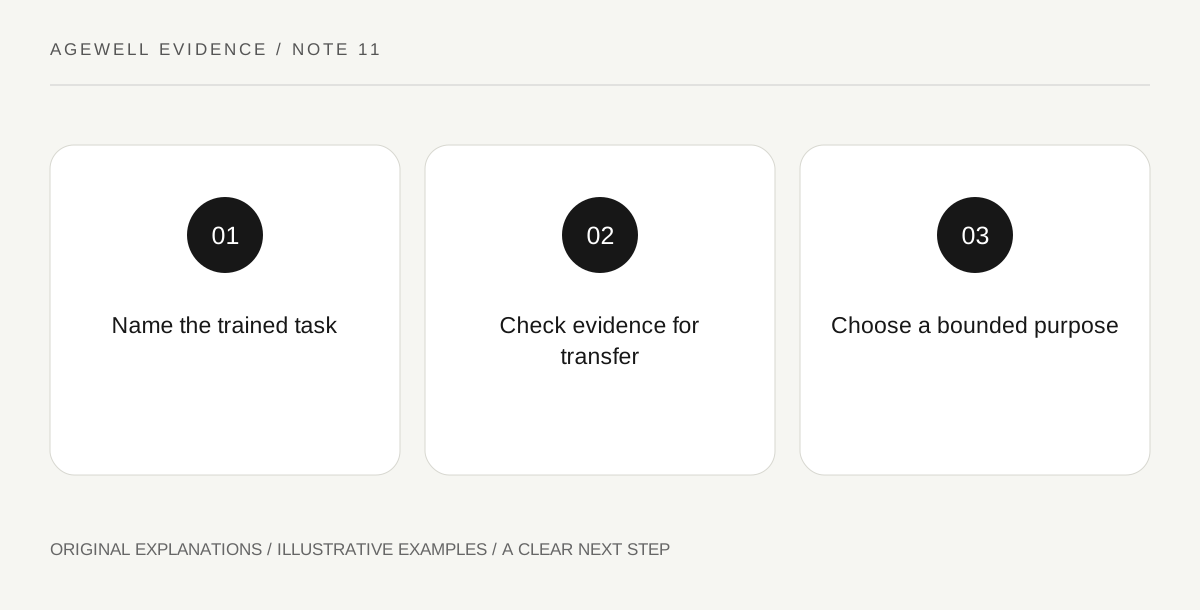
Original explanatory diagram. Read the full method and limitations below.
Name the task behind the score
A game might ask you to match symbols, remember a short sequence or respond quickly to a target. Its score reflects performance within that task and the rules of the program. Familiarity with controls, practice and strategy can change performance. None of those observations automatically tells you what happens when you manage bills, navigate a new place or remember a conversation.
Write the actual result in narrow terms: you completed a level faster or remembered a longer sequence. Avoid changing that into a statement that your brain became younger. A precise description preserves what you enjoyed and learned while keeping an unmeasured outcome unmeasured. It also makes the next evidence question much easier to ask.
Look for transfer to the outcome you care about
Transfer means an improvement extending beyond the trained task. Ask whether a study measured a similar laboratory task, an everyday activity or a clinical outcome. These are different questions. A trial that tests attention on a screen should not silently become proof of preventing dementia years later. Duration and the comparison group also matter.
If an advertisement refers to research, ask whether the tested program is the program being sold and whether the people studied resemble the intended audience. Look for the actual outcome and limitations. This is a focused reading task about transfer, not a demand that a hobby demonstrate clinical benefits before you are allowed to enjoy it.
Choose mental engagement for reasons you can verify
NIA discusses mentally engaging activities as part of cognitive health while noting uncertainty around some commercial brain-training claims. You can choose a language class, music practice, reading group or game because it interests you, fits your access needs and provides an enjoyable challenge. Those benefits do not require an unsupported prevention claim.
Consider whether the activity has a manageable interface, fair cost and a pace you enjoy. A streak system that turns every missed day into anxiety may not serve your purpose. A social activity may offer a reason to meet people, while a solo game offers convenient entertainment. State those practical values directly rather than assigning every activity a biological-age score.
Keep health concerns outside the app leaderboard
If memory or thinking changes are affecting daily life, seek assessment even when a game score improves. Conversely, a low score on an unfamiliar device does not diagnose disease. Difficulty seeing symbols, hearing instructions or operating controls can affect the experience. An app cannot replace a professional evaluation of a new concern.
Review the activity after a reasonable period in terms you can observe: do you enjoy it, can you use it comfortably and is the cost acceptable? Continue ordinary health care and advice. A decision to keep a puzzle game can simply mean it is a worthwhile pastime, without treating its marketing as evidence that it changes the course of aging.
An illustrative score interpretation
After a month, Ben completes a matching game more quickly. He describes that as practice within the game, not evidence that his work memory has improved. He keeps playing because he enjoys it and joins a reading group for discussion. When he notices a separate problem managing appointments, he raises it with his clinician.
Practical checks
Optional checkboxes save only in this browser.
Questions that come up
Are brain games useless if benefits are uncertain?
An activity can be enjoyable, convenient and challenging without proving a medical outcome. Decide whether those observable values justify its time and cost.
Can an app diagnose memory decline?
A consumer score is not a diagnosis. Ask a qualified professional about persistent changes in thinking or everyday functioning.
References and scope
These sources support the factual background. Examples and exercises are original illustrative teaching material. References do not imply endorsement.
- NIA: Cognitive Health and Older Adults — Cognitive health, research limitations and mentally engaging activities.