When conversation gets harder, change the setting and seek a hearing check
Missing part of a conversation can look like distraction when the actual problem is hearing. A useful response combines an accessible conversation environment with appropriate assessment. The aim is to keep participation possible while you find out what has changed, without treating a quieter person as confused or uninterested.
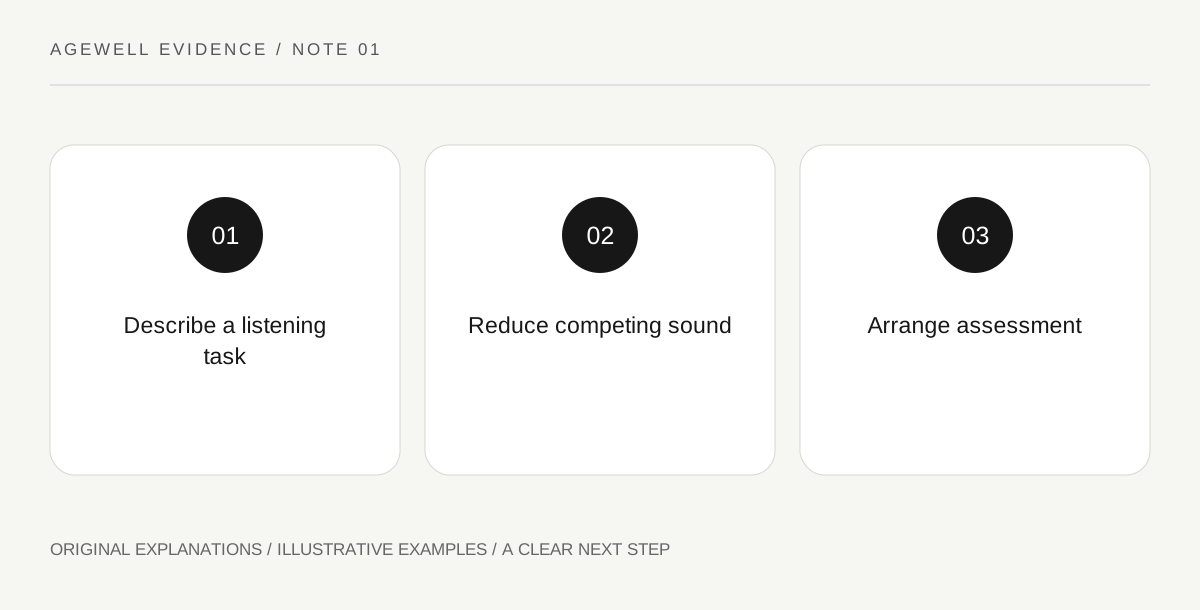
Original explanatory diagram. Read the full method and limitations below.
Notice the task that became difficult
Separate the situation from your interpretation. Was the difficulty following several speakers, understanding a telephone call, hearing a high voice or noticing an alarm? Write two recent examples with dates and surroundings. A description such as 'I heard the waiter but lost the words when music started' communicates more than 'my ears are old.' It also helps a professional understand the practical concern.
Notice whether the change seems gradual or sudden, and whether one ear seems different. Sudden hearing loss needs immediate medical attention; it should not wait for an ordinary shopping comparison. A home observation cannot identify the cause. Ear symptoms can have several explanations, so avoid cleaning deeply with objects or assuming that a device is the only possible answer.
Make a conversation easier to follow
Ask the group to reduce competing sound and take turns. Choose a place where you can see the speaker's face clearly, with lighting on the person rather than a bright window behind them. A quieter table at the edge of a restaurant can be more helpful than repeated requests to shout across a noisy room.
Make the accommodation specific: 'Please face me and say that last sentence again' is easier to act on than 'speak properly.' Rephrasing can help when simply repeating the same words does not. For important arrangements, ask for a short written confirmation. These changes support communication; they neither prove nor correct a particular degree of hearing loss.
Prepare a useful assessment conversation
Bring the situations you recorded and a current medicine list. Include exposure to loud work, hobbies or music and any associated symptoms. Ask who can evaluate hearing, what the assessment involves and how results connect with the tasks you find hard. Cost and service arrangements vary, so ask what is included before committing.
If devices are discussed, ask about fitting, follow-up, handling, cleaning and the setting in which you will use them. A television problem and a crowded meeting can present different challenges. Ask for realistic explanations instead of an assurance that one purchase restores every sound. Keep ordinary healthcare appointments accessible while the hearing question is being investigated.
Share responsibility for understanding
A conversation succeeds through both speakers' actions. Family members can stop talking from another room, get attention before starting and avoid covering their mouths. The person listening can explain which arrangements help and say when a message remains unclear. These are practical agreements rather than a test of patience or intelligence.
Review one setting after trying a change. Did moving away from the kitchen improve a family meal? Was the written appointment time clear? Use the answer to refine the setting, while following through on professional evaluation. A better conversation is worthwhile in itself; it does not need to be marketed as a way to reverse biological aging.
An illustrative family dinner
At a dinner for six, Mei misses remarks from across the table. The family turns off background television, seats her with a clear view of speakers and agrees on one speaker at a time. Mei writes down her continuing difficulty with telephone calls for a hearing appointment. The environmental improvement does not replace that appointment.
Practical checks
Optional checkboxes save only in this browser.
Questions that come up
Should relatives just speak as loudly as possible?
Clear speech, a visible face, less competing noise and rephrasing are often more useful conversation adjustments. Ask the listener what helps, and avoid assuming louder always means clearer.
Does hearing difficulty mean cognitive decline?
You cannot draw that conclusion from a missed conversation. Hearing and cognition are different questions. Make communication accessible and ask a qualified professional to evaluate continuing concerns.
References and scope
These sources support the factual background. Examples and exercises are original illustrative teaching material. References do not imply endorsement.
- NIA: Hearing Loss: A Common Problem for Older Adults — Hearing difficulties, communication adjustments and urgent assessment for sudden hearing loss.