Keep oral care manageable when grip or dexterity changes
A brushing routine can become difficult because a cap is stiff, a handle is thin or floss is hard to control. Treating the difficulty as an equipment and access problem makes it easier to discuss. Dental care still matters when teeth are missing, and pain or bleeding deserves professional attention.
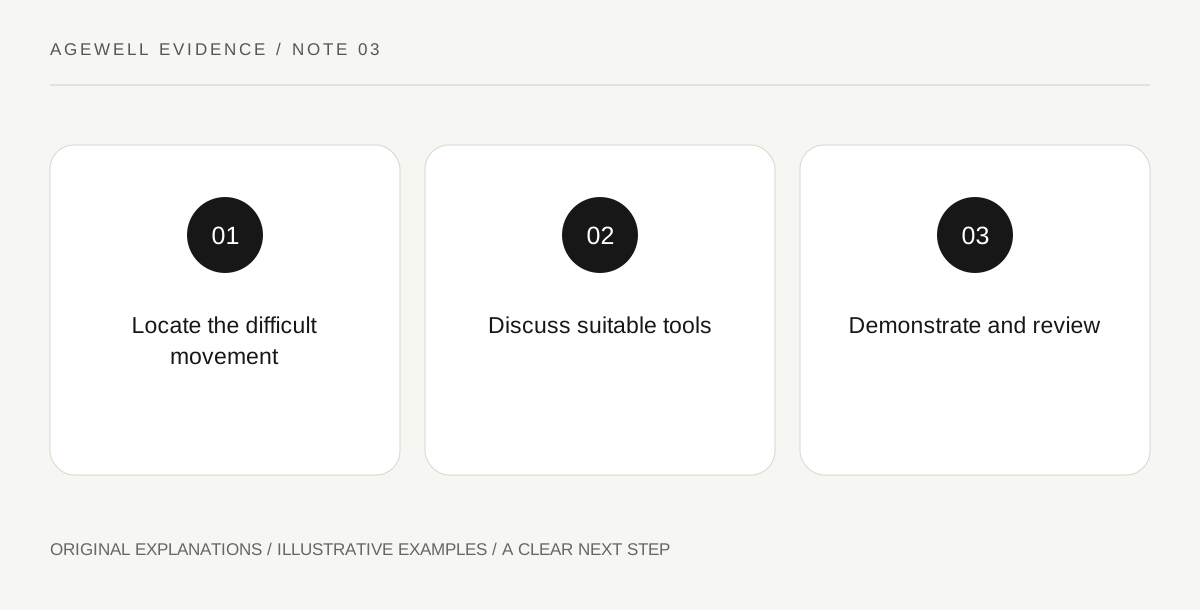
Original explanatory diagram. Read the full method and limitations below.
Find the awkward movement
Walk through the task slowly without forcing an uncomfortable grip. Is the problem opening toothpaste, holding the brush, reaching a surface or controlling floss? Identify the first point at which the routine becomes unreliable. A person may need a different handle rather than a stronger reminder to brush, and another may need assistance arranging supplies.
Describe what you can do comfortably and where help would be welcome. Do not let a supporter take over every step automatically. A stable place to sit, supplies within reach and a container that opens easily may preserve more independence than a complex new device. Discuss adaptations with a dentist or appropriate clinician if pain or hand limitations affect safety.
Ask about tools for the actual task
NIA discusses options such as larger-handled or powered brushes and aids for cleaning between teeth. Ask your dental professional which option fits your mouth, dexterity and technique. A powered product may reduce one kind of movement but still have a small button or a charger that is awkward to manage.
Try handling an unopened display model when available rather than judging only the package photograph. Check the weight, switch, replacement-head availability and whether you can clean and store it. The most elaborate tool is not automatically the most usable. Technique and consistent access matter, and instructions for a specific dental condition should come from the treating professional.
Make the setup serve the routine
Put daily tools in a clean, reachable position with enough room to handle them. Keep the pathway to the sink clear and use an appropriate stable seating arrangement if needed. Store products according to directions and keep personal tools identifiable in a shared bathroom. Avoid a crowded cup that makes every use a search.
If assistance is needed, agree on a respectful sequence: offer the chosen tool, ask before helping and give the person time. A supporter can prepare supplies while the person does the brushing. Write down any professional instructions so the routine does not depend on different helpers remembering different versions. Do not improvise restraints or painful methods to finish a task.
Keep the dental conversation broader than brushing
Tell the dentist about dry mouth, chewing difficulty, sores, bleeding or an uncomfortable denture. Bring a medicine list because some medicines can affect the mouth. Do not stop a medicine on your own to test that possibility. A practical adaptation helps access; it does not treat a cavity or diagnose why a symptom appeared.
Ask for a demonstration and repeat it back in your own words. Clarify which surfaces need attention, how an aid should be used and when to return. If the suggested routine is too difficult at home, say exactly where it fails. A useful plan is one that can be performed, checked and adjusted with professional guidance.
An illustrative handle change
Asha finds a narrow toothbrush difficult to rotate. At a dental visit she describes the movement and asks to see suitable alternatives. She chooses an appropriate wider handle after instruction and moves supplies to an uncluttered tray. Her partner opens the toothpaste when asked, while Asha keeps the parts of care she can manage.
Practical checks
Optional checkboxes save only in this browser.
Questions that come up
Does a powered brush remove the need for technique?
No. Ask how to use the chosen model and reach the relevant surfaces. An easier handle does not automatically make the whole routine effective.
Can I skip dental visits if I have dentures?
Dentures and the tissues of the mouth still need appropriate care and review. Ask your dentist about cleaning, fit and examination needs rather than assuming missing teeth end the need for care.
References and scope
These sources support the factual background. Examples and exercises are original illustrative teaching material. References do not imply endorsement.
- NIA: Taking Care of Your Teeth and Mouth — Oral hygiene, dental care, dry mouth and practical adaptations.