Review the bedroom-to-bathroom route before a nighttime stumble
A nighttime route can become harder when a bag appears beside the bed, light is out of reach or footwear slips. Looking at the route as a sequence reveals practical changes. Home adjustments can reduce hazards, but falls and near-falls also deserve a conversation about health, balance, vision and medicines.
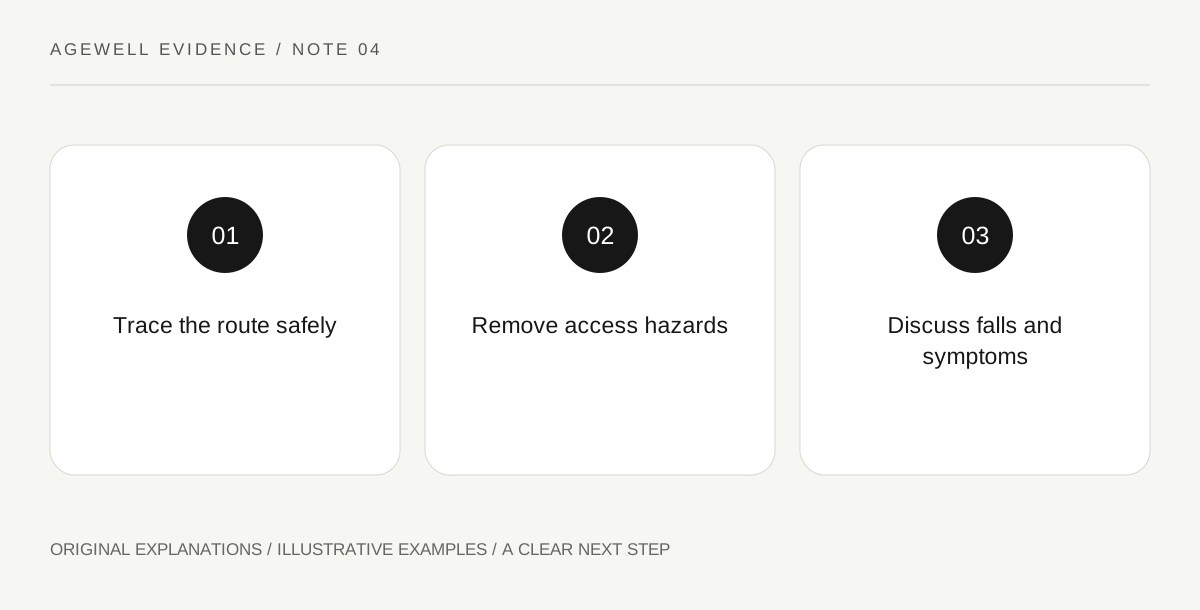
Original explanatory diagram. Read the full method and limitations below.
Trace the route in daylight
Start where you normally get out of bed and identify each transition: standing, finding light, turning through a doorway and entering the bathroom. Observe the route in daylight with another person if helpful. Do not recreate a dangerous dark walk to see whether you can manage it. Record obstacles and reach problems rather than blaming yourself for being careless.
Notice temporary objects as well as furniture. A laundry basket, charging lead or visitor's suitcase can change a familiar route. Check whether a door opens into the walking space and whether a rug edge catches. Keep necessary mobility equipment accessible in the arrangement recommended for you, instead of parking it where it looks tidiest but is difficult to reach.
Make lighting available before movement
A light is most helpful when it can be switched on before the difficult part of the route. Review switches, bedside access and illumination of changes in level. A bright patch followed by a dark doorway may still make navigation difficult. Ask for help choosing suitable lighting if the installation itself would require climbing or electrical work.
Avoid trailing extension cords across the route to solve a lighting problem. Consider how the system works during a power interruption and whether a reachable flashlight would be useful. Test controls while stationary and safely supported. This is a household access review; it does not establish that an individual can walk safely without the assistance already recommended to them.
Separate a hazard from a health change
NIA describes several contributors to falls, including medicines, vision and balance problems. Tell a health professional about a fall or repeated near-falls, even if a loose rug was present. The rug may be a real hazard while another factor also matters. Do not use a tidy room as proof that nothing medical needs attention.
Prepare a brief factual account: where it happened, what you were doing, whether you felt dizzy and what happened afterward. Mention relevant injuries and obtain appropriate urgent care when needed. A family member's description can help if you want support, but the person's own account should remain central. Avoid changing medicines or abandoning a prescribed aid without professional advice.
Agree on maintenance and help
A route audit is only useful if the arrangement stays usable. Give movable items an alternative home and agree that bags are not left beside the bedroom door. Ask who will replace a failed bulb and how to request help. Make changes with the person who uses the room rather than rearranging their familiar environment as a surprise.
Review the route when furniture, mobility or nighttime needs change. Suitable installed supports require appropriate selection and fitting; a towel rail is not automatically a grab bar. Keep the aim concrete: a clear, visible route and access to needed assistance. No home checklist can eliminate every fall risk or replace an individualized assessment.
An illustrative household adjustment
Luis finds himself stepping around a laundry basket on the way to the bathroom. The household moves it to a different storage spot and makes the bedside light reachable. He also reports two recent dizzy spells to his clinician. The practical room change and the health conversation address separate parts of the problem.
Practical checks
Optional checkboxes save only in this browser.
Questions that come up
Should I practice walking the route with my eyes closed?
No. Do not create an extra hazard to test yourself. Review the environment safely in daylight and ask for an appropriate professional assessment if walking or balance is a concern.
Does removing rugs guarantee there will be no falls?
No. Environmental hazards are only part of falls risk. Health, medicines, vision, balance and support needs may also matter, so combine household changes with relevant care.
References and scope
These sources support the factual background. Examples and exercises are original illustrative teaching material. References do not imply endorsement.
- NIA: Falls and Fractures in Older Adults — Falls risks, home changes, appropriate evaluation and bone health.