Start advance care planning with values before forms
Advance care planning is easier to begin with a conversation about what matters than with an unexplained stack of forms. It can help others understand your preferences if you cannot communicate later. Documents, decision-maker roles and legal requirements vary, so a values note supports rather than replaces appropriate professional and local guidance.
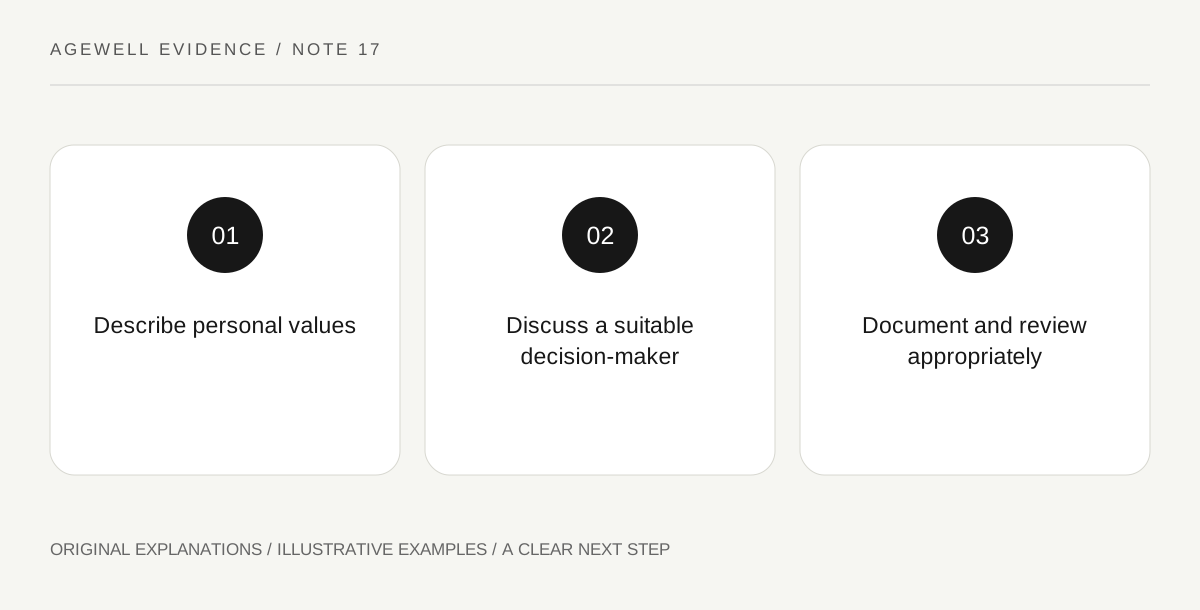
Original explanatory diagram. Read the full method and limitations below.
Describe what makes a day meaningful
Think about the activities, relationships and abilities that matter to you. You might value being able to communicate with family, spending time outdoors or having familiar people nearby. These statements give context for later medical conversations. They are not predictions of how you will feel in every possible circumstance.
Use a specific story to explain a value if helpful. An experience caring for a relative may have shaped your preferences, but your situation may differ from theirs. Avoid turning one difficult experience into a universal instruction about every treatment. The aim is to make your reasoning understandable so another person can ask the right questions when details are uncertain.
Choose a person who can listen and communicate
NIA describes a healthcare proxy as someone authorized to make decisions when you cannot, within the applicable arrangements. Discuss willingness, availability and the ability to represent your wishes. Being the closest relative does not automatically mean someone understands your preferences or is the person you would choose.
Ask the person to explain back what they heard. Resolve differences in understanding while conversation is possible. Talk about how they would communicate with clinicians and other family members. A values conversation should not become pressure to adopt someone else's preferences. The role is to support your decisions, not to choose the answer that is most convenient for the household.
Connect values to clinical questions
Ask a healthcare professional to explain unfamiliar treatments and how decisions may depend on the circumstances. General statements such as 'do everything' or 'nothing heroic' can mean different things to different people. A clinician can help translate the underlying concern into clearer questions without pretending that every future event can be predicted.
Write what remains unresolved. You may need another discussion about a particular treatment, a health condition or where care could be provided. Advance planning can be a series of conversations. Do not feel required to finish every decision in one sitting, and do not interpret an online scenario as a personalized recommendation for accepting or refusing treatment.
Make the plan accessible and reviewable
Use current local guidance for documents, witnessing, appointment of a decision-maker and any other legal requirements. A free-form note may be useful context without having the legal effect of a valid directive. Ask where copies should be held and how the care team will know a document exists.
Tell the relevant people where to find the current version and review it after major changes in health, relationships or location. Replace outdated copies through the appropriate process so conflicting instructions do not circulate. The practical goal is shared understanding and access when needed, not merely owning a signed document that nobody can locate.
An illustrative first conversation
Mina tells her chosen supporter that being able to communicate with family matters deeply to her. They discuss what that means and list questions for her clinician about possible future treatment decisions. She then checks the local requirements for appointing a healthcare decision-maker. Her values note is kept as context alongside any valid documents.
Practical checks
Optional checkboxes save only in this browser.
Questions that come up
Must I have a serious illness to start?
No. Planning can begin before a crisis. A calm values conversation may make later decisions easier to understand, while documents should follow local requirements.
Does a family chat replace an advance directive?
A conversation is useful but may not have the legal role of a properly completed document. Ask about the requirements and arrangements that apply where you live.
References and scope
These sources support the factual background. Examples and exercises are original illustrative teaching material. References do not imply endorsement.
- NIA: Advance Care Planning — Values conversations, healthcare proxies and advance directives with jurisdiction-specific requirements.