Bring specific memory examples to a health conversation
An occasional forgotten word and repeated difficulty managing familiar tasks are different observations. You do not need to diagnose the difference yourself to ask for help. Concrete examples, a timeline and information about daily function make a memory conversation more useful than either reassurance based on age or an online quiz result.
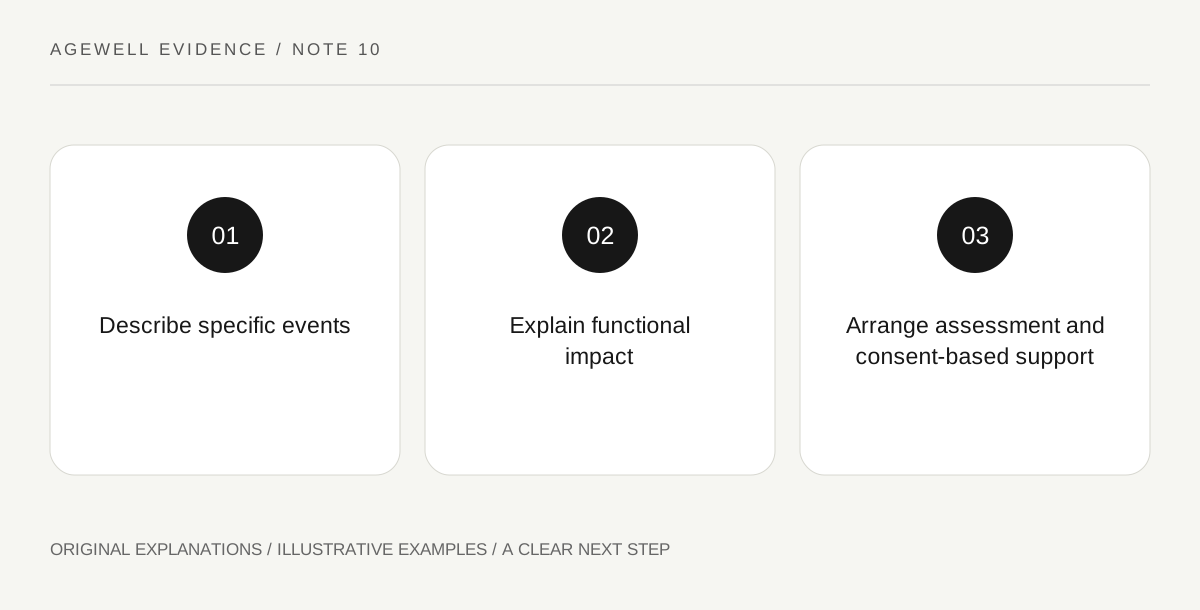
Original explanatory diagram. Read the full method and limitations below.
Write what happened rather than a label
Describe the event: missed an appointment despite a reminder, misplaced a familiar object or became confused during a routine journey. Include the date, context and whether the information returned later. Avoid writing only 'dementia' or 'normal aging.' Those labels can prematurely close the question that a professional needs to investigate.
Keep the account respectful. If you support someone else, ask whether they want your observations included and distinguish what you saw from what another relative reported. One person's joke about forgetfulness is not a clinical finding. The purpose is to make the conversation accurate, not to collect embarrassing examples or prove a disagreement within the family.
Explain the impact on ordinary tasks
Tell the clinician whether the concern affects paying bills, preparing food, keeping appointments or following medicine instructions. A change in these tasks may require practical support while assessment proceeds. The level of help needed matters more than whether a person performs well on a casual word game at dinner.
Consider sensory and communication barriers too. If someone could not hear an instruction or read a tiny label, describe that rather than counting it automatically as a memory failure. Arrange glasses, hearing support and an accessible conversation environment for the appointment. These measures improve participation; they do not establish that memory is normal or explain every difficulty.
Include context a clinician can evaluate
Bring medicine information and mention sleep, mood, recent illness and other health changes. NIA explains that memory problems can have different causes, including some that may be treatable. This is not a basis to choose a cause yourself. Ask what assessment is appropriate, what the next step is and when you should return.
Online tests and app scores are limited. Save a result if it prompted concern, but do not use it to diagnose disease or dismiss symptoms. If a sudden confusion or other acute change occurs, seek prompt medical help. A long-term memory appointment is not a substitute for urgent assessment of a rapid new problem.
Build support around consent and reliability
Agree on one or two practical supports, such as a shared appointment calendar or a clear place for important items. Ask what the person wants help with and who is authorized to assist. Avoid removing all responsibility based on a single mistake. Equally, do not insist on independence in a task that has become unsafe while waiting for a label.
After an appointment, write the agreed next step and who will arrange it. If the situation changes, contact the care team as advised. A useful support system can evolve with needs and preferences. It should not depend on family members repeatedly arguing about whether the person is trying hard enough to remember.
An illustrative shared note
Rina and her father prepare a note together after he misses two familiar appointments. They record the dates and his explanation, then include a recent medicine change and difficulty hearing telephone reminders. They arrange a health visit and choose written reminders meanwhile. The note does not claim that hearing, aging or a particular disease caused the misses.
Practical checks
Optional checkboxes save only in this browser.
Questions that come up
Can a high brain-game score rule out a problem?
No. A game tests a limited task under particular conditions. Bring concerns about everyday function to a qualified professional even if an app score looks reassuring.
Should relatives keep a secret mistake diary?
Aim for respectful, accurate communication and involve the person when possible. Distinguish direct observations from interpretation and discuss support needs with appropriate professionals.
References and scope
These sources support the factual background. Examples and exercises are original illustrative teaching material. References do not imply endorsement.
- NIA: Memory Problems, Forgetfulness, and Aging — Memory concerns, everyday functioning and professional assessment.