Describe pain by what it changes in your day
Pain is easier to discuss when a clinician can understand where it occurs, how it feels and what it prevents you from doing. You do not have to accept persistent pain as a normal feature of getting older. A useful description supports assessment without requiring a self-diagnosis or a treatment chosen online.
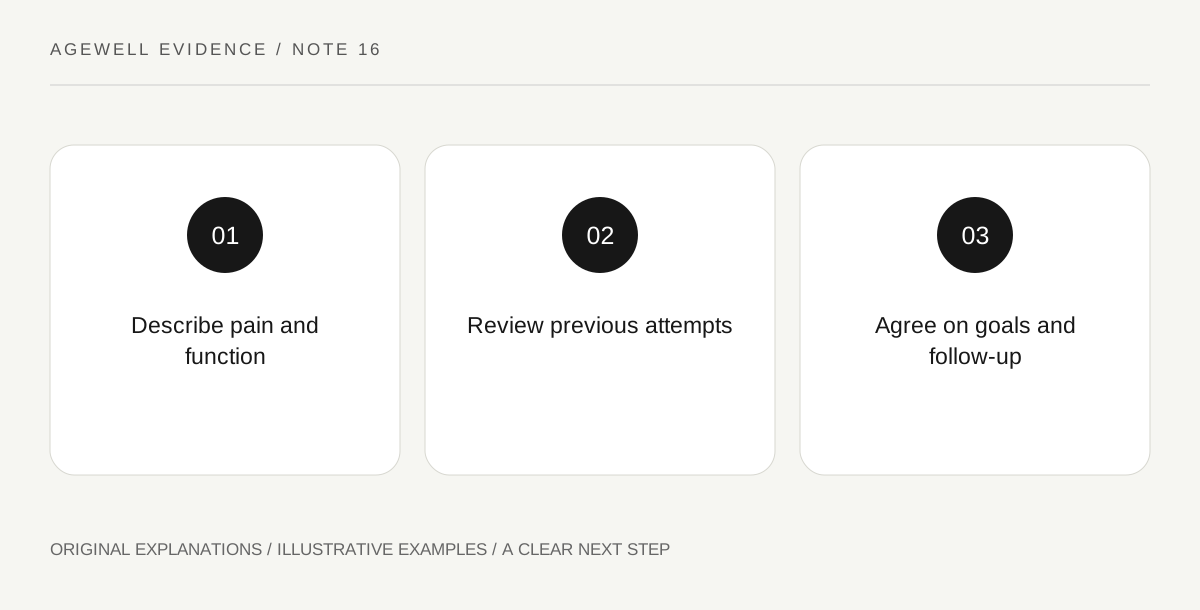
Original explanatory diagram. Read the full method and limitations below.
Connect location, timing and activity
Describe where the pain is, when it started and whether it comes and goes. Explain whether it occurs at rest, during a movement or after a particular task. Ordinary words such as aching, burning or sharp can be useful if they match your experience. There is no prize for choosing a medical-sounding term.
Add a functional example: pain interrupts sleep, makes standing at the stove difficult or changes how you dress. A number on a rating scale can help a clinician, but it does not replace the activity context. If symptoms are sudden, severe or otherwise concerning, seek appropriate urgent care rather than waiting to assemble a detailed record.
Explain what you have already tried
Bring the names and directions of prescribed and over-the-counter products, as well as non-medicine approaches. State what helped, what did not and any unwanted effects. Include products used only occasionally. NIA emphasizes discussing the safety and appropriate use of pain treatments with a clinician.
Do not increase a dose or combine products because the previous attempt seemed weak. Different packages can contain overlapping ingredients. A pharmacist can help interpret actual labels, while a clinician evaluates the pain and treatment plan. An online list of remedies cannot determine whether a product fits your health history, medicines or cause of pain.
Set a meaningful care goal
A useful goal might be preparing a simple meal, sleeping more comfortably or reaching a nearby shop. Ask how the proposed plan relates to that goal and how progress will be reviewed. Pain relief, function and unwanted effects may need to be considered together. The answer is not always captured by asking whether every sensation disappeared.
If a recommendation is difficult to carry out, explain the barrier. Transport, cost, equipment or an inaccessible handout can make a theoretically clear plan unusable. Ask about appropriate alternatives. Do not copy someone else's exercise or treatment sequence because they describe a similar body area; similar words can conceal different causes and needs.
Keep review and escalation explicit
Before leaving, clarify what to do if pain continues, changes or treatment causes problems. Ask whom to contact and when follow-up is expected. Keep a concise note of the plan, including any professional instructions about activity. A supporter can help remember details if you want, but the explanation should remain understandable to you.
At follow-up, compare the goal with your experience. If standing to cook remains difficult despite a lower pain rating, say so. Avoid judging care only by whether you can tolerate more discomfort silently. A manageable plan recognizes daily life, preserves dignity and allows revision as information emerges, without promising that a single product or technique solves every form of pain.
An illustrative functional goal
Arun tells his clinician that hand pain makes opening jars and fastening a shirt difficult. He brings the products he has tried and asks for a plan focused on those tasks. At follow-up he reports that dressing is easier but jars remain a problem. That distinction helps review the plan more precisely than 'a bit better.'
Practical checks
Optional checkboxes save only in this browser.
Questions that come up
Must I know the cause before making an appointment?
No. Describe your experience and its impact. Assessment is the professional's role; you do not need to arrive with a diagnosis.
Is persistent pain unavoidable with age?
Do not dismiss it on that basis. A clinician can assess possible causes and discuss appropriate ways to manage pain and function.
References and scope
These sources support the factual background. Examples and exercises are original illustrative teaching material. References do not imply endorsement.
- NIA: Pain: You Can Get Help — Describing pain, its effect on activities and treatment discussions.