Bring dry-mouth difficulties into both dental care and meal planning
Dry mouth can change how food feels, how easily you speak and how comfortable eating becomes. It also has oral-health implications, so it deserves more than a new drink bottle. A practical response combines a dental or medical conversation with adjustments that fit your existing dietary and swallowing advice.
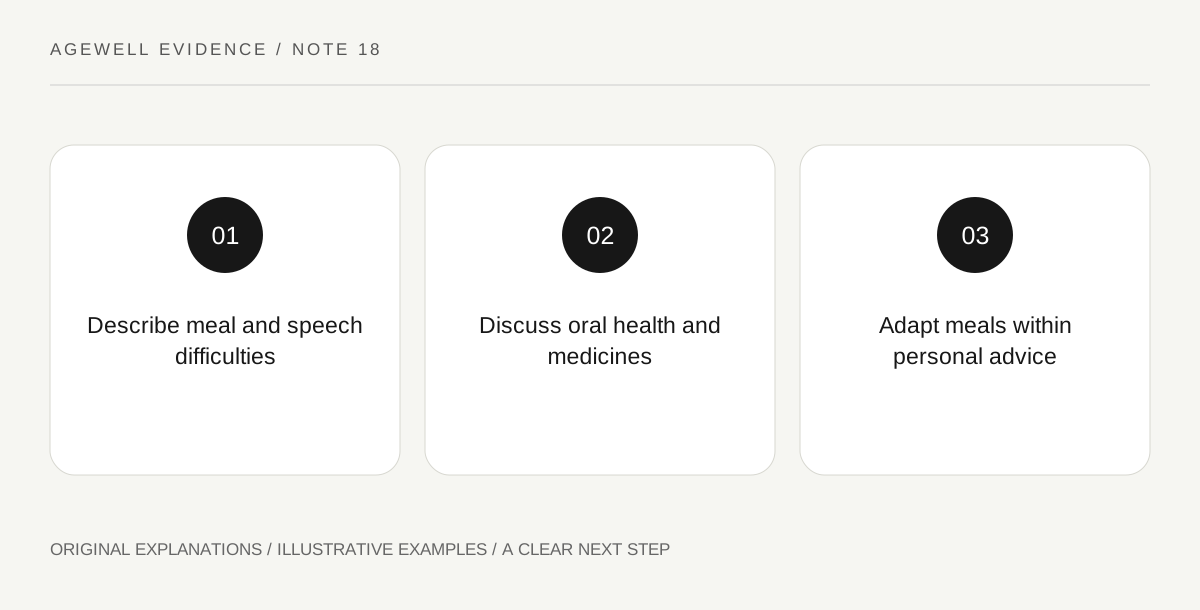
Original explanatory diagram. Read the full method and limitations below.
Describe the difficult moments
Notice whether dryness is most troublesome on waking, while speaking, during meals or throughout the day. Write down what becomes difficult, such as swallowing a dry cracker or speaking through a long phone call. NIA explains that inadequate saliva can affect eating, taste and oral health. Your description helps identify the problem's practical scope.
Bring the timing of symptoms and a current medicine list to your dentist or clinician. Some medicines may contribute, but do not stop them yourself. Avoid assuming that dryness proves dehydration or a particular disease. If you have difficulty swallowing or another concerning symptom, ask for appropriate assessment rather than treating it as a texture preference.
Ask about oral-health protection
Tell the dentist about dryness even if there is no tooth pain. Ask what cleaning, fluoride or other measures are appropriate for your situation and how often review is needed. A general mouthwash bought for freshness may not address the concern. Product selection should reflect professional advice and actual directions.
If a product is recommended, ask how it should be used and what it is meant to do. Keep that role separate from a promise to cure the cause. Report discomfort or lack of benefit as advised. Oral care remains important with dentures, and an ill-fitting denture or sore tissue should not be managed by repeatedly adding more adhesive or avoiding the appointment.
Make meals comfortable within your care plan
Consider moist familiar foods and sauces that fit any dietary restrictions, and discuss persistent eating difficulty with an appropriate professional. A dry sandwich may be less comfortable than a similar filling served with a suitable moist component. These are meal-design possibilities, not a swallowing treatment or a reason to change prescribed food texture.
If you have fluid restrictions, ask your clinician how to manage dryness without exceeding them. Do not follow a universal water target from a lifestyle article. Avoid automatically adding sugar-rich drinks throughout the day to make the mouth feel wet. Ask about options that fit oral health and personal medical needs rather than solving one discomfort by creating an unrelated problem.
Coordinate helpers and follow-up
If someone prepares meals for you, explain the specific problem and the professional instructions you want followed. 'Please include a suitable sauce separately' is more actionable than 'make something easier.' Keep preferences visible so meals remain enjoyable, and ask for help with packaging or preparation when needed.
Review whether the practical change improved the eating experience and tell the care team if dryness persists. Watch for reduced food intake or unintentional weight change and report it. A more comfortable meal is useful, but it does not establish that the underlying cause has resolved or that oral-health risks no longer need attention.
An illustrative lunch adjustment
Evelyn finds a dry roll difficult to eat and mentions this alongside persistent mouth dryness at her dental visit. She brings her medicine list and asks about appropriate oral care. At home she chooses a familiar lunch with a suitable moist component, following her existing food advice. She does not stop medicine or impose a large fluid increase.
Practical checks
Optional checkboxes save only in this browser.
Questions that come up
Is dry mouth only a comfort issue?
No. Saliva helps protect the mouth, and dryness can be relevant to tooth decay and other concerns. Discuss persistent symptoms with a dentist or clinician.
Should everyone drink much more water?
Personal needs vary, particularly with fluid restrictions or certain health conditions. Ask your clinician how to manage the symptom appropriately.
References and scope
These sources support the factual background. Examples and exercises are original illustrative teaching material. References do not imply endorsement.
- NIA: Taking Care of Your Teeth and Mouth — Oral hygiene, dental care, dry mouth and practical adaptations.