Use a near-fall as information before it becomes a forgotten story
A stumble that ends with grabbing a chair can be easy to dismiss because no injury occurred. It can still reveal a route problem, dizziness or a change in confidence. A concise account helps you address practical hazards and discuss repeated near-falls without turning the incident into a self-test.
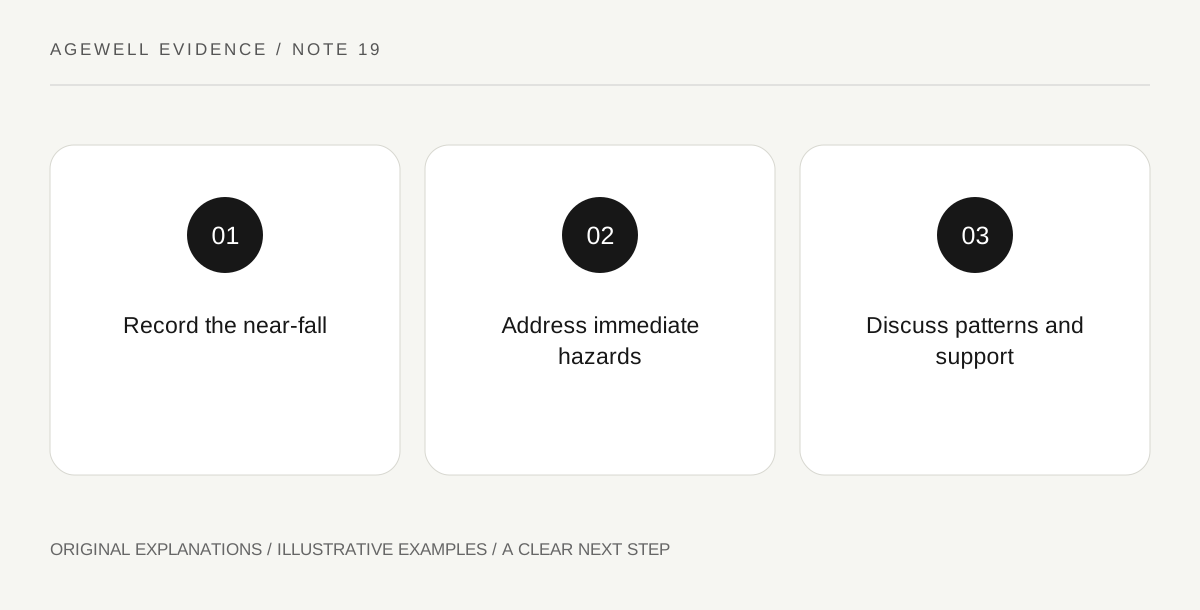
Original explanatory diagram. Read the full method and limitations below.
Reconstruct the sequence calmly
Write where you were, what you were doing and what happened just before losing balance. Include footwear, lighting, surfaces and any object you were carrying. Distinguish a trip over a visible obstacle from feeling dizzy before a step. You do not need to choose the cause; the sequence is useful on its own.
Avoid reenacting the event to prove exactly how it happened. A person who reached for furniture once should not be asked to repeat an unsupported movement for a video. If an injury, head impact or concerning symptom occurred, seek appropriate care. The absence of an obvious bruise does not settle every medical question.
Identify the immediate practical change
If a bag, spill or loose cable was involved, remove or address it safely. If a frequently used item is stored too high, ask for help arranging accessible storage instead of improvising a climb. Keep changes visible and agreed with the person who uses the space. An unexpected furniture rearrangement can introduce a new navigation problem.
Treat a grab for furniture as a sign to ask about appropriate support rather than assuming any chair is a reliable aid. Mobility equipment requires suitable selection and use. Do not borrow a cane because it is available or alter its height based on appearance. A qualified professional can advise when support or a mobility assessment is needed.
Tell a professional about recurrence and symptoms
NIA explains that falls have multiple contributing factors. Report repeated near-falls, dizziness, new unsteadiness or fear that is changing your activity. Bring a medicine list and describe recent health or vision changes. A household obstacle and a health factor can coexist, so finding one does not rule out the other.
Ask what evaluation or support is appropriate and what symptoms should prompt urgent help. Do not stop a medicine because its leaflet mentions dizziness. A clinician or pharmacist can review the actual plan. If fear has led you to avoid ordinary activities, say which activities and ask how to maintain participation safely while the concern is addressed.
Review confidence without forcing a challenge
A useful follow-up asks whether the practical arrangement is easier and whether the person can access needed assistance. It does not demand that they prove independence by repeating a risky task. Support can include a more accessible route, help carrying items or professionally recommended mobility arrangements.
Keep the incident note brief and available for appointments. If nothing similar happens again, the record still provides context. If episodes recur, dates and descriptions help avoid relying on vague memory. The aim is earlier attention to patterns, not constant surveillance or blaming a person for moving too slowly, asking for help or feeling uncertain after a frightening moment.
An illustrative near-fall note
Wei catches himself on a counter while carrying laundry through a dim doorway. He records the sequence and asks the household to move the basket storage. Because he also recalls a separate dizzy episode, he contacts his clinician and brings his medicine list. Nobody asks him to repeat the stumble to demonstrate it.
Practical checks
Optional checkboxes save only in this browser.
Questions that come up
Does no injury mean there is nothing to discuss?
Not necessarily. Repeated near-falls or associated symptoms can be useful information for a health professional, even when you did not hit the floor.
Should I borrow someone else's walking aid?
Ask for appropriate advice. Fit, purpose and technique matter, and an available aid is not automatically suitable for you.
References and scope
These sources support the factual background. Examples and exercises are original illustrative teaching material. References do not imply endorsement.
- NIA: Falls and Fractures in Older Adults — Falls risks, home changes, appropriate evaluation and bone health.