When smell changes, review household warnings and the meal experience
A change in smell can affect appetite and the ability to notice warning odors. It deserves assessment and a practical review of household systems. Replacing smell-based decisions with reliable procedures can help, but no home sniff test establishes why the change happened or whether a food is safe.
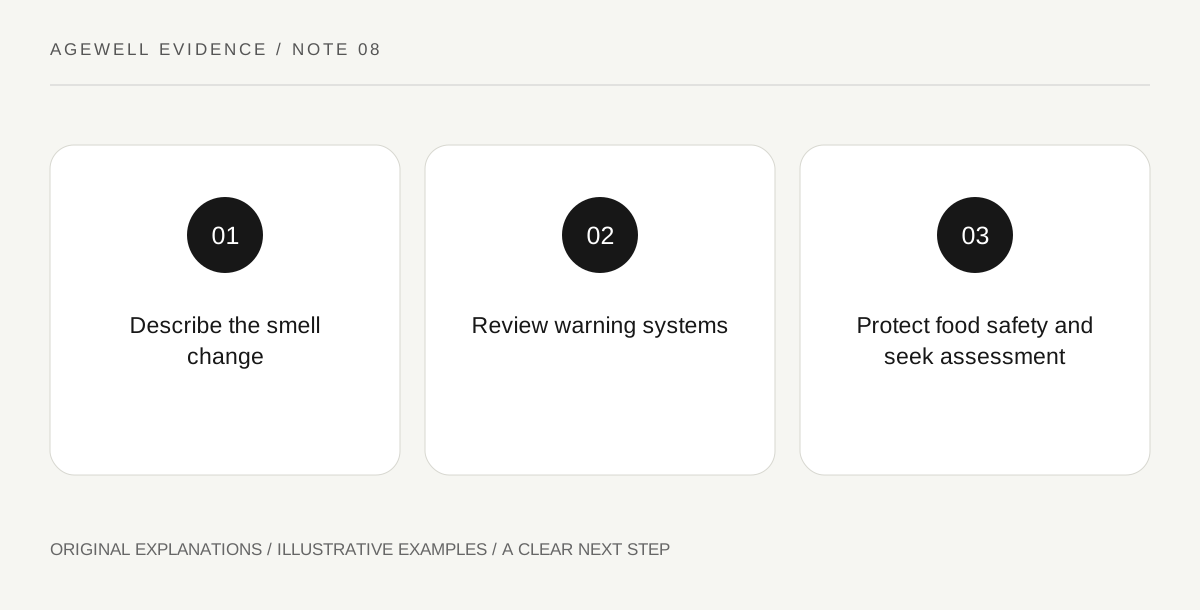
Original explanatory diagram. Read the full method and limitations below.
Separate reduced smell from distorted smell
Describe whether familiar odors seem weaker, absent or different. Write when the change began and whether it followed an illness, injury or a change in products or medicines. NIDCD explains that smell disorders have several forms and causes. Your description helps a professional ask better questions without requiring you to choose a diagnostic label.
Do not use strong cleaning chemicals, smoke or a gas source to test your nose. That creates exposure rather than useful evidence. If you notice a possible gas leak or another immediate hazard, follow local emergency procedures and leave the area as appropriate. A reduced sense of smell is a reason to rely on functioning warning systems, not a reason to investigate a dangerous odor more closely.
Review warnings that should not depend on a nose
Check that appropriate smoke and carbon monoxide alarms are present and maintained according to manufacturer and local safety guidance. Carbon monoxide cannot be detected by smell even by someone with a normal sense of smell. Ask a qualified person about any fuel-specific detector needs rather than assuming one alarm detects every household hazard.
Write who tests equipment and replaces batteries or units when required. A device stored unopened in a drawer does not provide protection. Make alarms accessible to hearing needs as well as smell concerns. The household plan should explain how people leave and call for help, rather than ending at a checked box beside the word detector.
Use dates and storage rules for food
Smell is not a reliable food-safety test. Label prepared food, follow appropriate refrigeration and storage guidance and discard food when its safety is uncertain. A supporter can help read labels or organize the refrigerator without making the person depend on someone else sniffing every meal. Keep food and cleaning products clearly separate.
For enjoyment, consider familiar foods with varied colors and textures that suit any swallowing or dietary instructions. Ask a health professional if changed smell is affecting appetite or weight. Do not compensate automatically by adding large amounts of salt or sugar. The aim is a satisfying eating experience while the cause and nutritional implications are discussed appropriately.
Bring the functional impact to an appointment
Tell the clinician if you cannot notice cooking odors, if favorite foods now seem unpleasant or if eating has become difficult. Bring a current medicine list and relevant history. Ask which professional can assess the concern and what evaluation may involve. Do not stop medicines or start supplements based on an unconfirmed theory about the cause.
Keep a short list of practical changes that helped, such as a clearer food-label system or a more appealing texture. Report persistent symptoms or further changes as advised. A household adjustment can improve daily life without proving recovery. Avoid buying a product simply because its advertising suggests that one scent or supplement restores every form of smell loss.
An illustrative kitchen review
David notices that coffee smells unusually faint and mentions a recent illness at his appointment. At home he checks the household alarm-maintenance plan with a family member and labels refrigerated leftovers by preparation date. For meals he chooses familiar textures and colors. Nobody uses a spoiled-food sample or a cleaning chemical to test him.
Practical checks
Optional checkboxes save only in this browser.
Questions that come up
Can another person smell leftovers to prove they are safe?
No. Harmful contamination may have no obvious odor. Storage history and food-safety guidance matter even when a food smells ordinary.
Should I test smell with bleach or gas?
No. Avoid hazardous exposures. Describe ordinary experiences and seek professional assessment instead of creating a dangerous home test.
References and scope
These sources support the factual background. Examples and exercises are original illustrative teaching material. References do not imply endorsement.
- NIDCD: Smell Disorders — Smell changes, possible causes, assessment and safety implications.